FIG 0.1
Path, or no claim
algo.SPpaths looks for the causal chain from a change to the symptom. If FalkorDB returns no path, the change is out, whatever the model thinks.
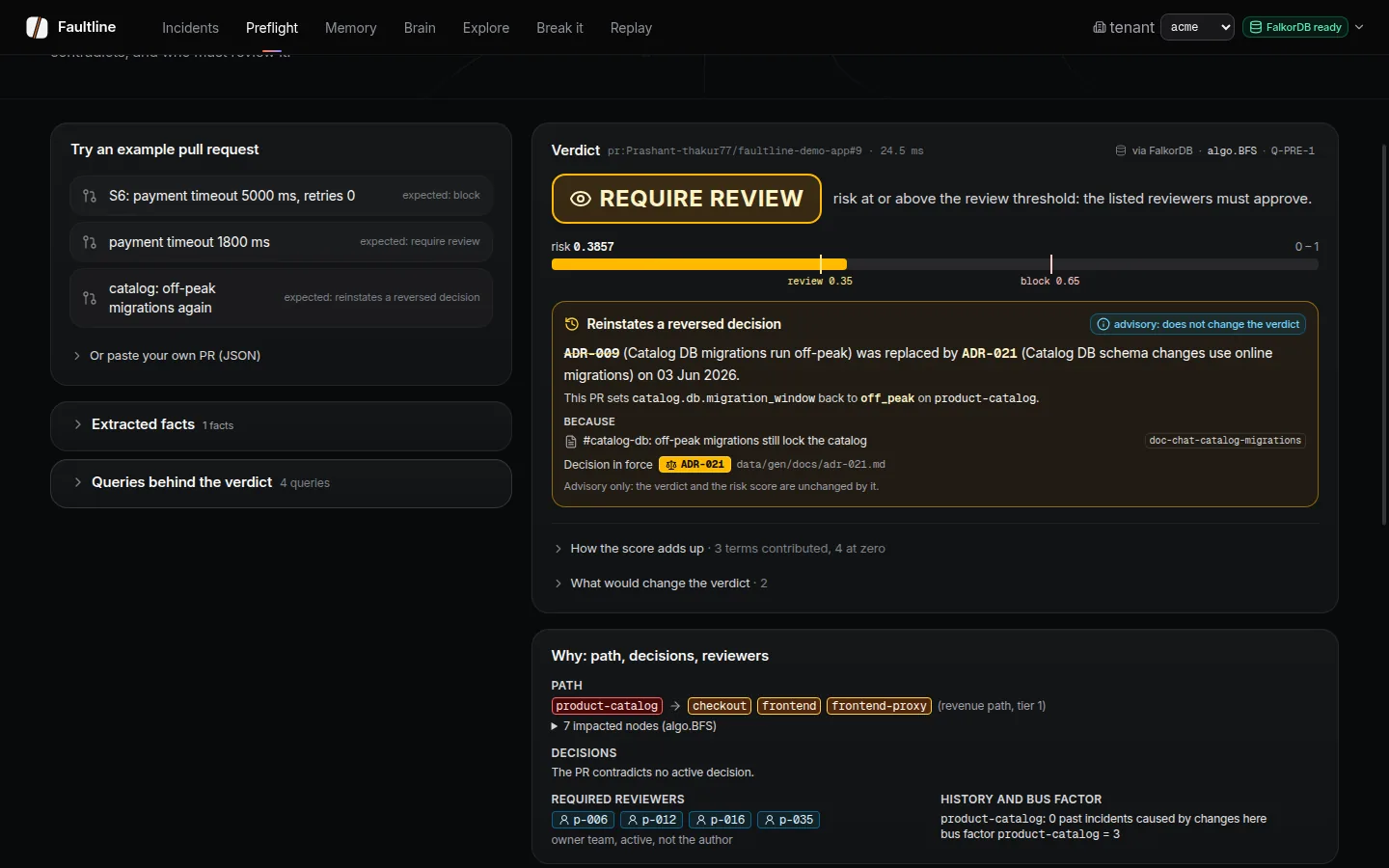
Faultline won't blame a deploy until FalkorDB proves it: a causal path from the change to the symptom, and enough capacity on that path to carry the impact. Otherwise it says “I don't know”.
Safetylower is better
–confident wrong blames in – generated test worlds built to trap it. The trade: –/– right causes · – of – handed to a human
Versus an LLMsame worlds
–confident wrong blames by a strong LLM alone (claude-opus-5-5) given the same telemetry on the same – worlds: it names –/– right causes, but nothing checks its guesses against the graph
Real serviceslower is better
–wrong blames in – windows of the OpenTelemetry Demo's real services and telemetry, broken with its own fault flags (our topology and decoys): –/– right causes. A threshold on the same telemetry: – wrong
Measured and pre-registered · evals/results/latest.json
FIG 0.1
algo.SPpaths looks for the causal chain from a change to the symptom. If FalkorDB returns no path, the change is out, whatever the model thinks.
FIG 0.2
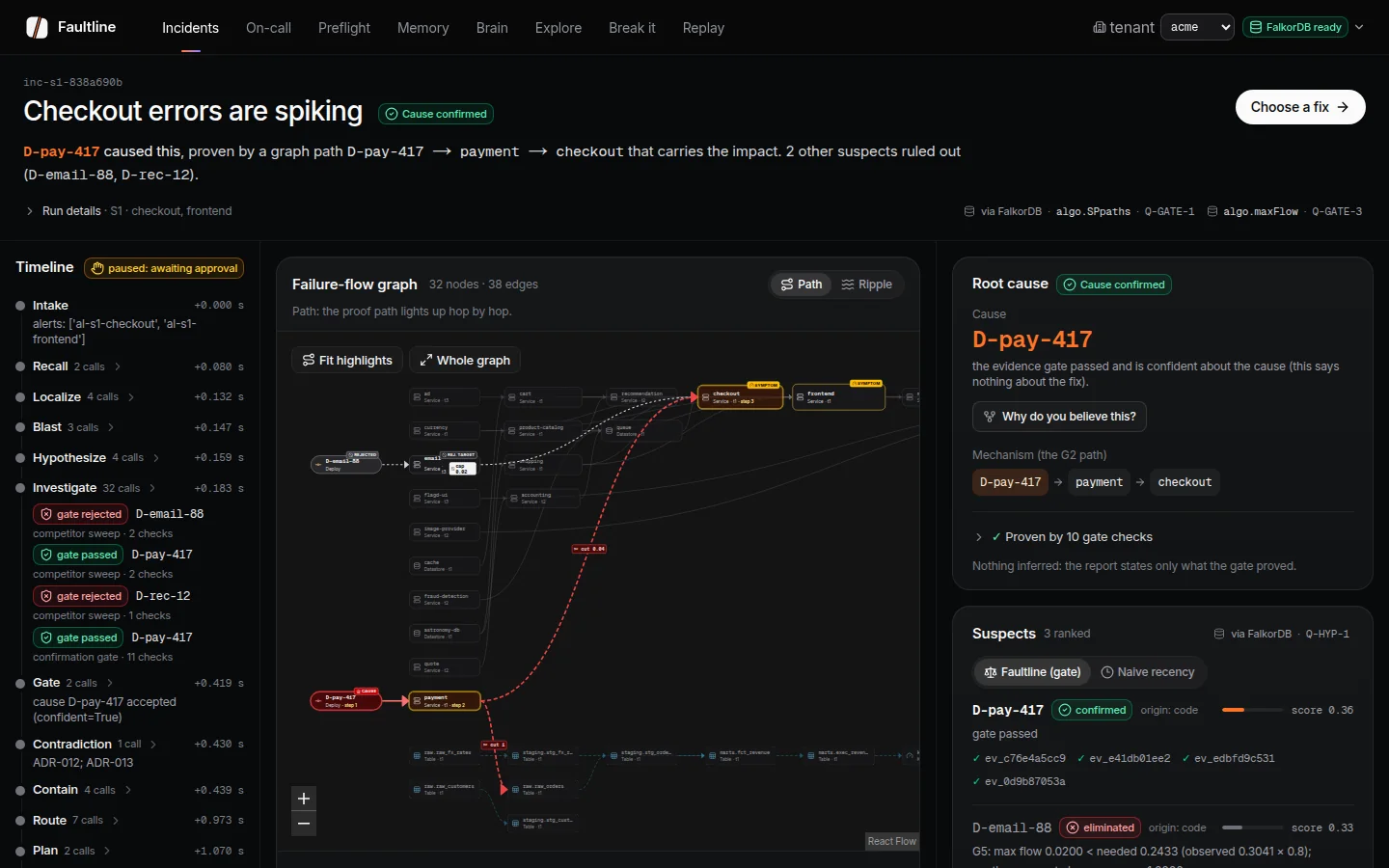
algo.maxFlow bounds how much of the impact a suspect can explain. A same-minute deploy on a best-effort edge carries 0.02 of it: rejected.
FIG 0.3
The containment is the min-cut, tried first on a GRAPH.COPY clean room with a predicted outcome; then one human-approved action, verified.
The loop. Evidence comes in from the systems you already run, every verdict is a FalkorDB query, and one approved action goes out and is written back.
algo.WCC
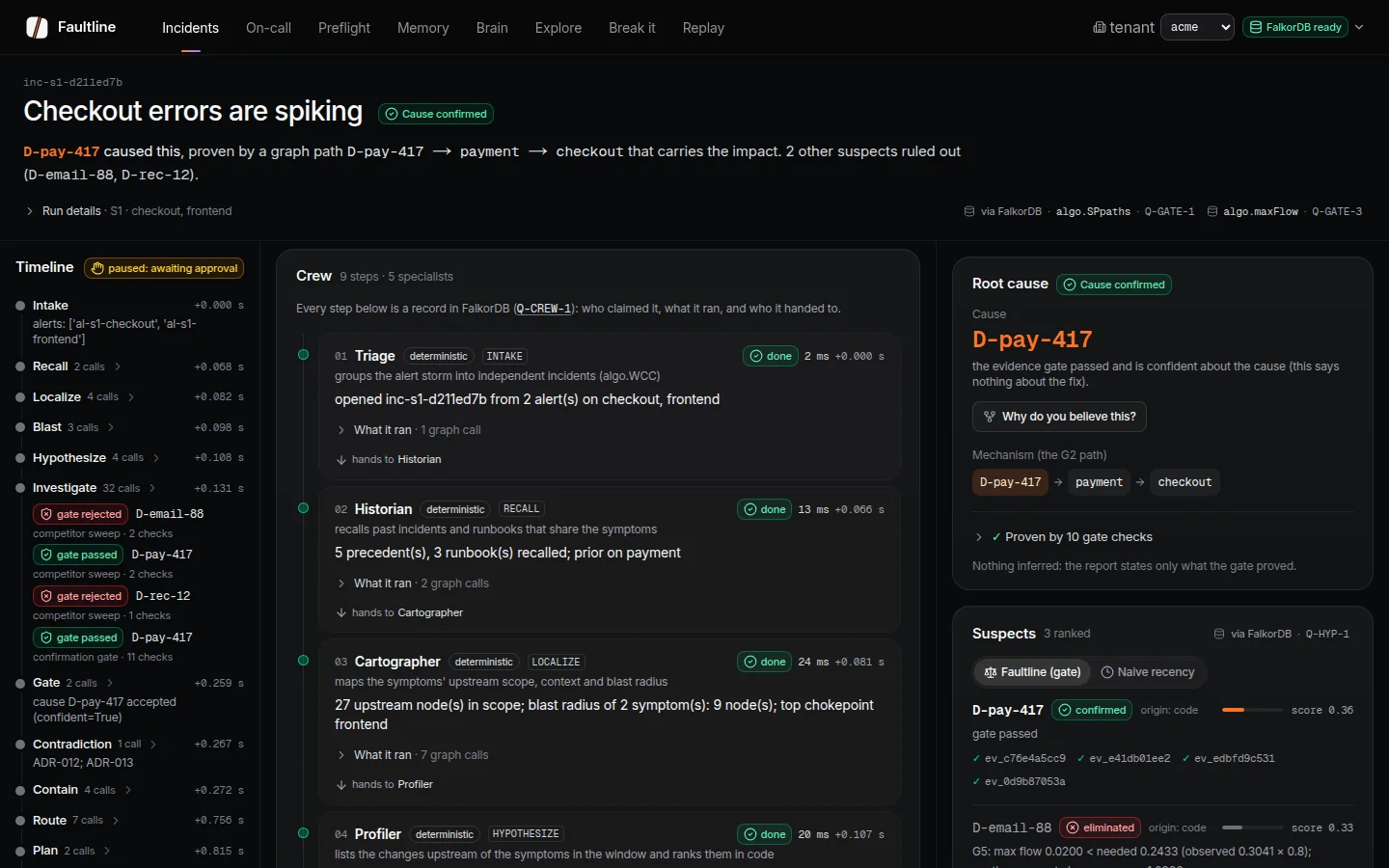
Checkout and frontend page at once. Weakly connected components over the failure edges group the storm into incidents, so two faults never blend into one story. The search then runs upstream from the symptom.
CALL algo.WCC({nodeLabels: ['Node'], relationshipTypes: ['PROPAGATES_TO']}) YIELD node, componentIdWITH node, componentId WHERE size(coalesce(node.alerts, [])) > 0G2 · algo.SPpaths
Three deploys landed in the same few minutes. D-rec-12 changed recommendation, and FalkorDB returns no path from it to checkout. No path, no claim: it is out before any model reasons about it.
MATCH (c:Node {id:$cause}), (s:Node {id:$symptom})CALL algo.SPpaths({sourceNode: c, targetNode: s, relTypes: ['CHANGED', 'GATES', 'PROPAGATES_TO'], weightProp: 'w', relDirection: 'outgoing', maxLen: 8, pathCount: 3}) YIELD path, pathWeightG5 · algo.maxFlow
A path is not enough. D-email-88 reaches checkout over a best-effort edge whose max flow is 0.02, far below the share of the impact it would need to carry. Rejected.
MATCH (t:Node {id:$symptom})CALL algo.maxFlow({sourceNodes: srcs, targetNodes: [t], relationshipTypes: ['PROPAGATES_TO'], capacityProperty: 'cap'}) YIELD maxFlowRETURN maxFlow AS max_flow, size(srcs) AS sourcesthe path is the proof
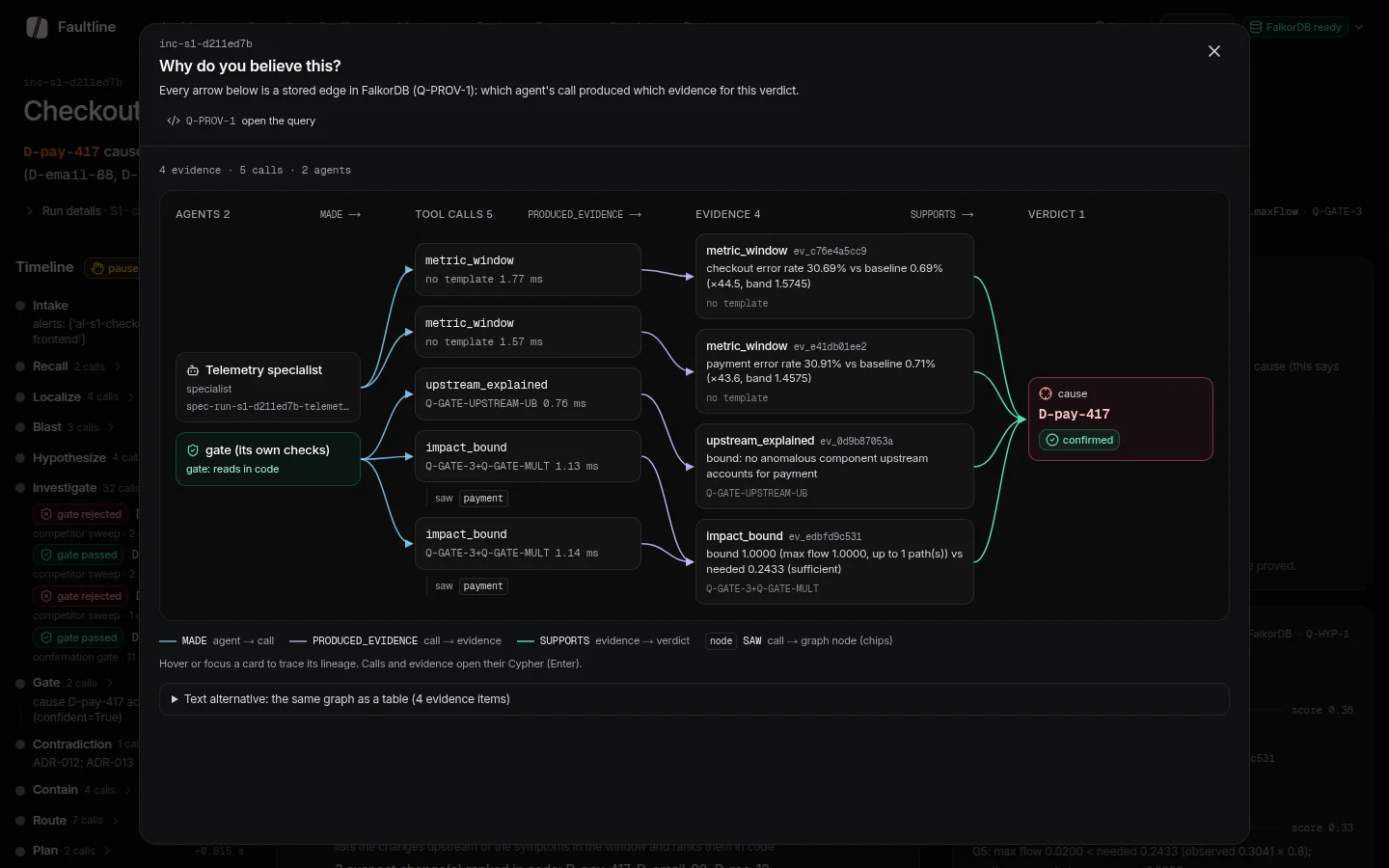
D-pay-417 → payment → checkout, and the flow carries all of it. The chain comes back hop by hop and is drawn as returned; a hop learned from an earlier incident names that incident.
RETURN [n IN nodes(path) | n.id] AS chain, [r IN relationships(path) | type(r)] AS rels, pathWeight AS weight, length(path) AS hops,[r IN relationships(path) | coalesce(r.from_incident, '')] AS learned_frommin-cut · GRAPH.COPY
The smallest containment is the min-cut out of payment, computed from max-flow's edge flows. Every option is tried on its own GRAPH.COPY of the tenant graph first, with a predicted outcome.
CALL algo.maxFlow({sourceNodes: [f], targetNodes: prot, relationshipTypes: ['PROPAGATES_TO'], capacityProperty: 'cut_cost'}) YIELD edges, edgeFlows, maxFlowRETURN [e IN edges | [startNode(e).id, endNode(e).id]] AS flow_edges, edgeFlows AS flows, maxFlow AS max_flowtwo-step approval
A human approves the exact plan: flag paymentGate off. A second channel verifies it as APPLIED, the decision is written back, and a separate read-only connection re-reads every id, so the next incident starts warm.
MATCH (inc:Incident {id:$inc})OPTIONAL MATCH (c:Node {id:$cause})-[:CAUSED]->(inc)OPTIONAL MATCH (inc)-[:RESOLVED_BY]->(a:Action {id:$aid})Product tour
01Incident room
The stage timeline, the failure path lit hop by hop, and every suspect the gate tried, each ruled in or out by a query you can open.
Open it live: Incident room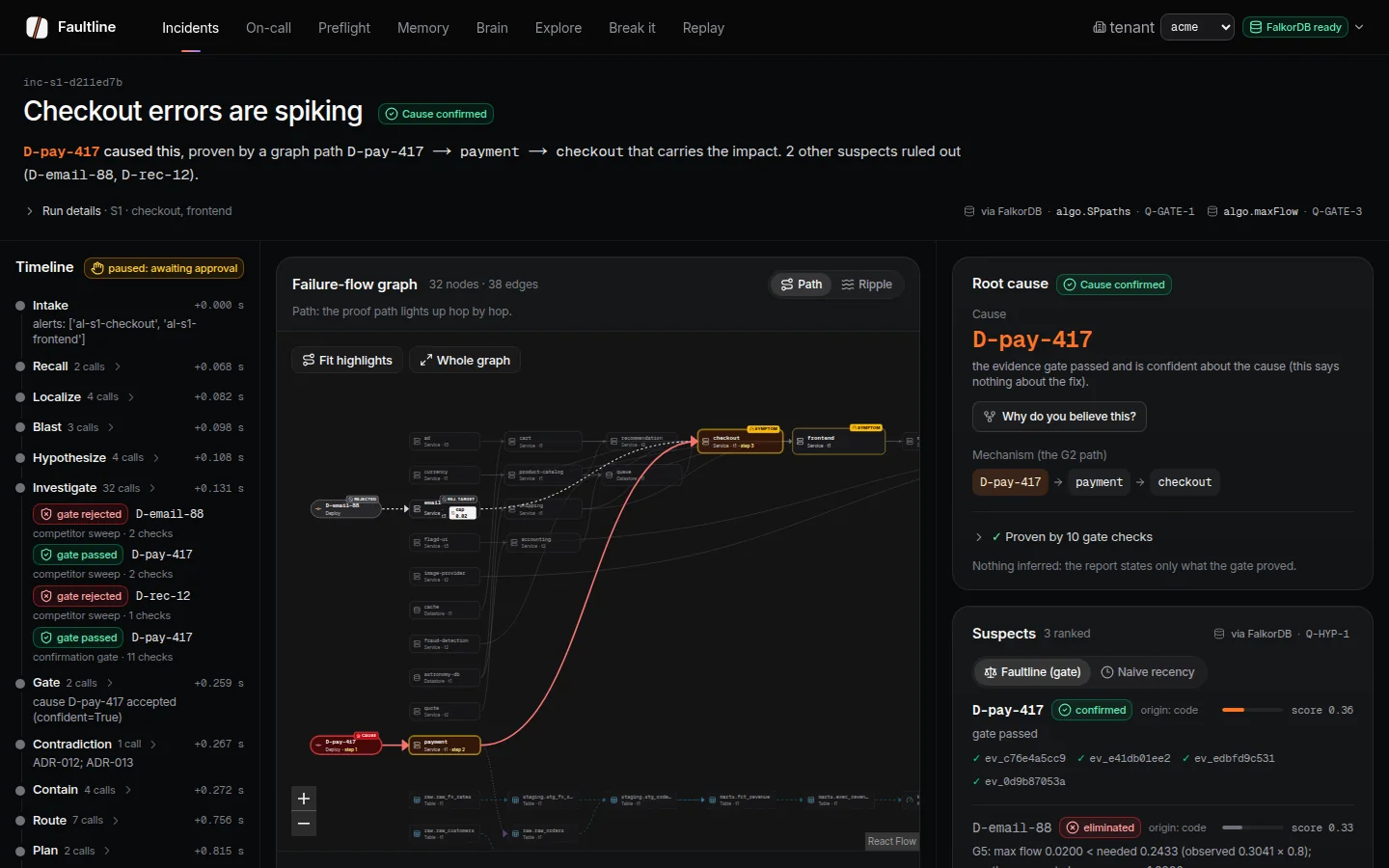
For agents
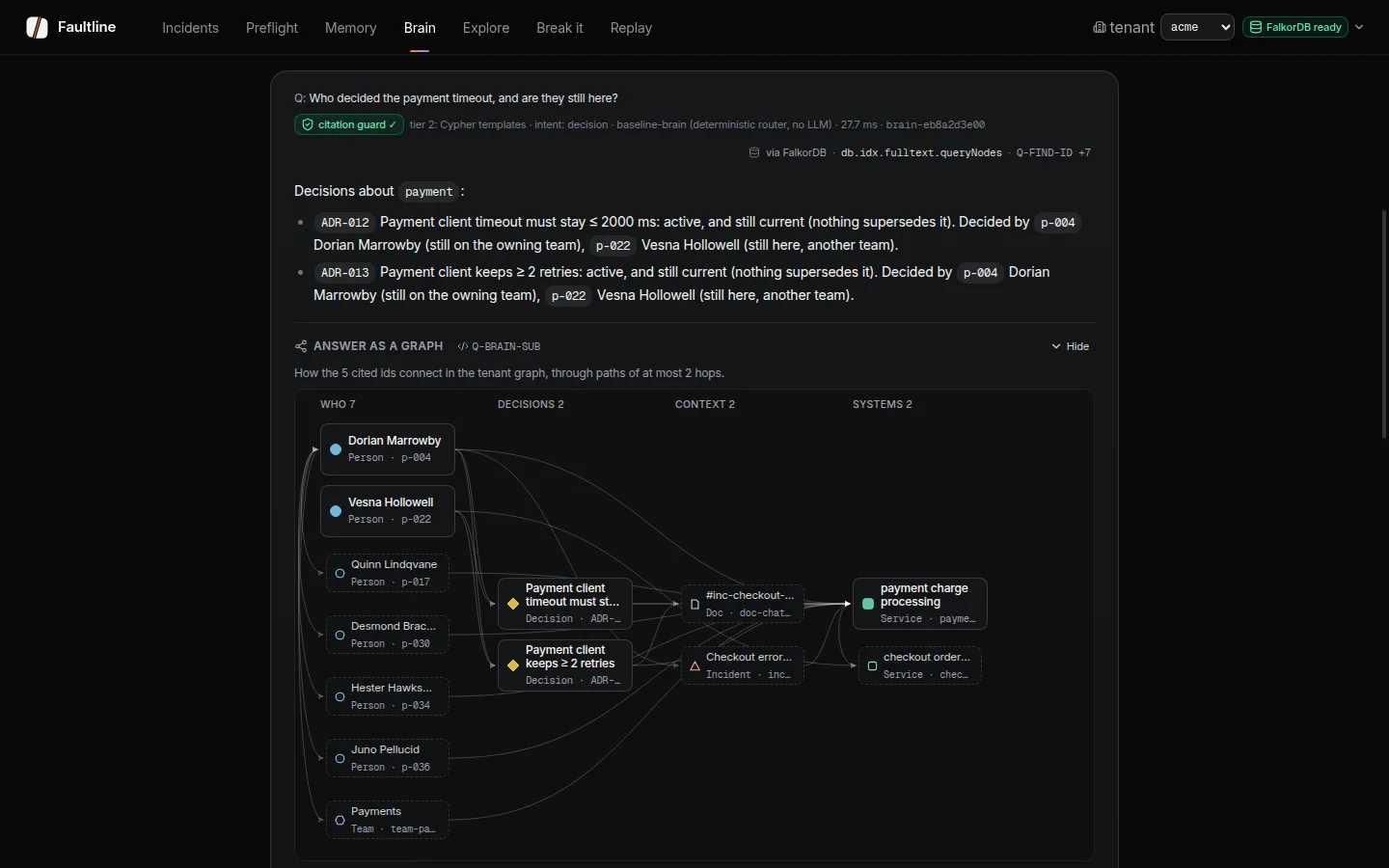
Plug the graph into any agent. Every tool answers with the Cypher it ran, its parameters and a digest of the rows.
{ "mcpServers": { "faultline": { "command": "npx", "args": ["-y", "@prashantthakur77/faultline-mcp"] } }}Each run below was recorded from a real Faultline run and exported from its graph (stage events, tool calls, gate runs, hypotheses, the plan and the report). This site is static files only: it calls no API and no database, needs no API key, and computes nothing. The player steps through the recorded events in their recorded order.
The live demo runs the agent against FalkorDB: make up && make seed && make demo (source: github.com/Prashant-thakur77/Faultline).
Getting started
No. The deterministic investigator and every check run keyless. A model may only propose; a read-only query decides. LLM runs are optional and capped by an hourly budget.
To use it: Docker alone. docker compose -f quickstart.yml up pulls the images, seeds the demo graphs and serves the UI, the API and the MCP endpoint; an npm package gives any MCP client the read-only graph tools with one npx line (both below). To check every number: Docker, uv and Node, then make setup && make judge-check, which runs every check keyless and prints PASS.
It says so. The UI shows the outage and a run cannot start: it fails loudly and never answers from stale or fake data.
No. It takes one human-approved action, bound to the exact plan by its hash, and verifies the result through a second channel. A result it cannot confirm goes back to a human and is never recorded as a success.
The engine and every query are real. The demo data is synthetic and public: an OpenTelemetry-Demo-shaped topology and a synthetic org with its history, decisions and runbooks. One benchmark runs on a real system: the OpenTelemetry Demo itself, broken with its own fault flags and read through its real telemetry.
From evals/results/latest.json, regenerated by the eval harness. make claims fails on any number that drifts from it.